On October 12th we gathered at the Yarra Edge Theatre of the Melbourne Polytechnic Fairfield campus where their Education Manager, Creative Arts (music, sound and screen production), Daniel Bodnarcuk presented on the twin topics of
Future-Proofing Audio Education: From Emerging Workflows to AI
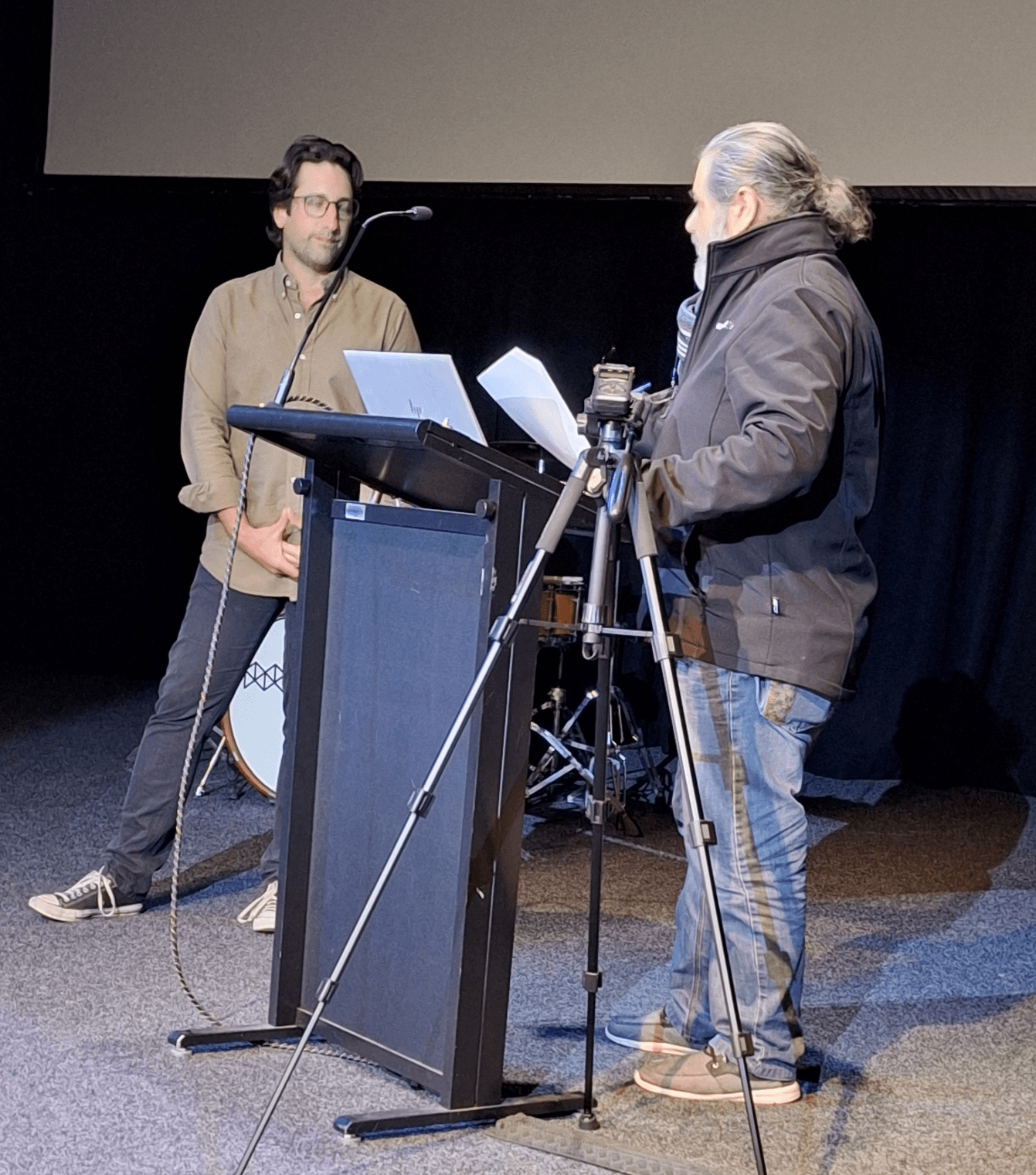
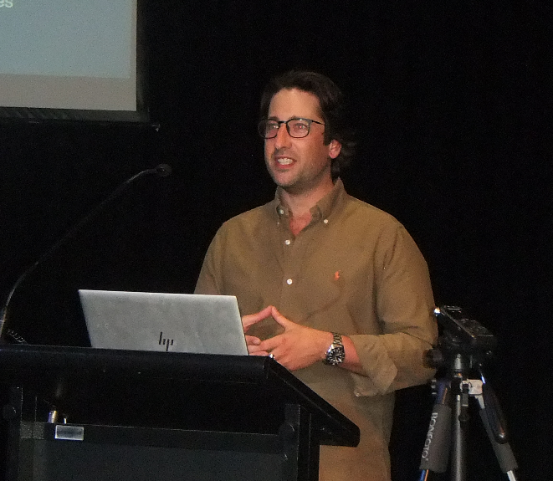
Following an introduction from Vice-Chair, Paolo Menolotto, Daniel presented his research on how educators can keep pace with emerging technology. This was followed by his examination of the possibilities of Artificial Intelligence in audio production and education, including the vexed issue of copyright.
The research was supported by an international fellowship, with backing from the AES, Melbourne Polytechnic, the Victorian Skills Authority and RMIT. It was also presented at AES conferences overseas.
Daniel started with what he calls an “alignment gap”. He described how technology advances exponentially, but vocational education (VET) training packages are redeveloped only every three to five years. He saw that as too slow for new tools and workflows to reach the classroom. His fellowship study looked into what leading educators and institutions around the world are doing about this.
His report identified five themes, based on a literature review, interviews and institutional visits (including the UK and the 2024 AES Madrid conference):
Curriculum agility. Teaching principles and workflows rather than specific tools.
Industry collaboration. Moving from consulting industry to genuine collaboration, built on shared value. One UK institution included an industry touchpoint in every unit, such as real briefs from record labels or students testing a manufacturer’s new audio interface.
Interdisciplinary and cross-cultural approaches. Building diversity into how tasks are approached, and run small “interdisciplinary sprints” rather than large, assessment-heavy projects.
Innovative teaching. Rewarding the process and individuality behind an outcome, not just the outcome. Reducing hierarchy in practical settings (the teacher as “lead engineer”) also helps inclusion.
Professional development. Leaders giving grassroots communities of practice the space and autonomy to develop, rather than forcing them.
Daniel then introduced the concept of Fast Loops and Slow Loops, an idea he picked up from a Dutch institution. Slow loops are formal curriculum updates, such as the annual planning window or a full training package revision. They are heavily constrained by compliance. Fast loops are short, frequent cycles inside a unit, where the learning outcome stays fixed but the tool is changed. Educators identify a new tool, trial it, gather feedback, adjust and repeat. Findings are then recorded and fed into the slower review cycles.
Daniel noted that classroom experimentation already happens but is rarely documented in a way that informs larger updates. He plans to formalise this into a workflow at his organisation.

He then moved to practical demonstrations of generative AI in audio engineering and music production.
Using a voice conversation with ChatGPT, he described a drum-kit mic setup, including a faulty channel to skip, specific microphones and a room mic polar pattern. He used shorthand terms to refer to the mics (“57’s top and bottom on the snare, a pair NT-5’s as overheads” etc.) and the AI appeared to know which microphones he was referencing. The AI produced an Excel input list with his notes and emailed it to him after a permission prompt. The aim was to show AI as a practical studio assistant, not a replacement for student thinking.
To evaluate and work around room acoustics, he supplied room dimensions, the speed of sound and the axial mode formula, and asked for a 3D visualisation of the first six axial modes, with close-together modes flagged. The model’s numbers were consistent, though its approach and visuals varied between runs. His advice was to also request the raw data as a spreadsheet.

Daniel then outlined the field of Generative Music as of late September. He highlighted Suno Studio 2 and the emergence of “vibe mixing”, meaning editing and mixing through conversational prompts rather than parameter tweaking. He also covered Moises (stem separation) and various mixing and repair tools. He framed AI in production as three levels: assist (software proposes settings), automation (software builds a balance or processing chain) and fully generative (the model supplies performance, arrangement and recording).
In live demonstrations he then generated a bossa nova track from a ChatGPT-written prompt; created an AI voice model from a sung sample and recorded a guitar riff for the model to build on, using ChatGPT for lyrics and a style prompt; and split the result into stems using Moises Studio for completion in a conventional DAW, by re-recording parts.

His point was that the value for a producer lies in the workflow and in command of language. He also acknowledged that he found parts of the process uncomfortable.
Copyright and Industry Response
In examining the impact of AI-generated music on the industry, Daniel noted that Deezer, a music streaming platform similar to Spotify reported about 90,000 fully AI-generated tracks uploaded per day as of June 2026, and on peak days it could be up to 50% of new uploads.

He also highlighted that The Australian Recording Industry Association (ARIA) has recently ruled that AI-assisted work is eligible for listing in their charts, but humans must perform the lead vocal and primary instruments. AI may support backing vocals or production, but fully AI-generated music is ineligible.

Regarding Licensing, he reported that major labels are striking deals with Suno. Paid Suno users receive commercial usage rights, but copyright protection is not guaranteed. Suno takes a broad, perpetual, royalty-free licence over anything uploaded, including for future model training, so users must hold full rights to what they upload.

Daniel then raised the question of whether the output be used commercially. Can it be protected by copyright, and were the training inputs lawfully used?
He noted that APRA/AMCOS’s concerns are consent, transparency, credit and fair remuneration.
The Q&A session followed covering both the educational and AI aspects of Daniel’s presentation. While answering one question, he revealed how he had built a tutor agent for a specific piece of studio hardware. It is restricted to the manuals and coaching guides and follows educator-set rules. It can explain things in a student’s first language and ends each session by compiling evidence of the student’s work for the lecturer. He suggested this as one way to address assessment, though his institution has not yet decided what data it can put into such tools.
One attendee related how students are fearful of AI taking the fun out of creative careers. Daniel said his team does not use Suno as a teaching tool. They are careful about which tools enter the classroom, and want students informed without being frightened. Audience members expected a creative backlash leaning toward intimate, human performance.
Questioned on what rights remain after accepting Suno’s terms, Daniel likened them to an unfavourable label deal. He stressed teaching creation over output as a product, and originality.
In response to a stated concern about students failing to learn as they lean on AI to complete coursework, he suggested that creative arts faculties should design assessments that reward process and originality, which reduces the risk of AI-written submissions.
We thank Daniel for his interesting and informative presentation which gave us all new insight into the future of audio education, and the potential role of Artificial Intelligence in music creation and production.
We also thank Melbourne Polytechnic (https://www.melbournepolytechnic.edu.au/study/music-and-sound/) for providing the venue, and besides Daniel, tech officer Clinton Sigmund who willingly gave of his time and talents to set up and operate the AV and streaming systems so that Daniel’s talk could be viewed live online and recorded for later viewing on YouTube.
Here’s a video of Daniel’s presentation
It is also available for direct viewing on our YouTube channel at:
https://youtu.be/rn1SY75zn9M
Daniel’s two sets of slides, as PDF documents, can be viewed here
https://aesmelbourne.org.au/wp-content/media/Advancing_Education_Standards_Globally.pdf
and
https://aesmelbourne.org.au/wp-content/media/AI_inside_the_music_studio.pdf
Related links:
Melbourne Polytechnic https://www.melbournepolytechnic.edu.au/study/music-and-sound/
Daniel’s Papers
https://drive.google.com/file/d/1Rwimq27cP3TVkSn3qR0PUOz80n3EqifV/view
and
https://drive.google.com/file/d/1-6mX_46lOxBx5TnVz21QkyzjphHyAi63/view
Chat GPT https://chatgpt.com/
Claude AI https://claude.ai/new
Suno https://suno.com/discover
https://suno.com/studio
Moises Studio https://studio.moises.ai/play
Peter Smerdon
16 October 2026